Showing posts with label Gifu 岐阜. Show all posts

Wednesday, 14 January 2009

Shirakawago [白川郷]

Several villages spanning Shirakawago [白川郷] and Gokayama [五箇山] make up the UNESCO world heritage site, which protects the traditionally, steep-sided thatched roofs of these farm houses. Luckily for us, it had snowed a little the night before so it looked quite pretty.


a view of Ainokura [相倉] and a Gassho [合掌] in Ogimachi [荻町]

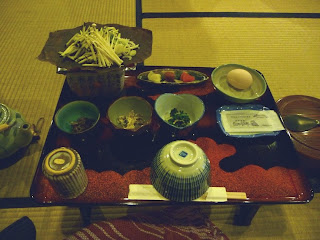
We had booked in to stay in one of the Gassho's, which provided hefty dinners and breakfasts. The first Gassho that we stayed in was also entertaining two other familys; both familys had four generations with them; a great grandparent, grandparents, mothers and fathers and several children. In total about 16 people were seated around the main tatami room eating dinner.


Dinner and breakfast...and there was alot more than is shown in the photos...
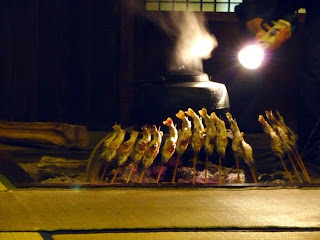


Fishies being cooked in the open fire in the middle of the tatami room. Despite there being no visible form of ventilation in the room the room was not smoky at all. Which was a bit strange. Sadly we were quite far from the fire, so it was also rather chilly at our side of the room.
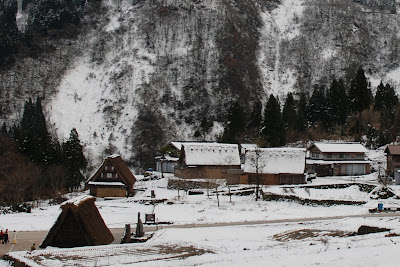


Small Village of Ainokura [相倉] made up of traditional Gassho-style farm houses [合掌]

The second Gassho we stayed in, was smaller but much cosier (only 8 guests, only 2 of which were Japanese). The room was quite nice here, as was the food....


We found our places to stay through this website [http://www.vill.shirakawa.gifu.jp/e/] just click on 'Accomodation' in the index, and it will take you to a list of places to stay. Generally you have to phone up the place to book.

Tuesday, 13 January 2009

More Takayama [高山]


Some more photos of Takayama [高山] that we took whilst doing the hiking trail around the temples around the northern edge of town.

Monday, 12 January 2009

Takayama [高山]

Takayama [高山] is famous for its;
・Old Private Houses - Furui-machi-nami [古い町並]: Recognised as a site National Preservation area of Historically Important Buildings
・Hida Beef - [飛騨牛]: Tasty beef which rivals Kobe's famous brand and which has also been in the news for cloning...(here)
・Sarubobo dolls - [さるぼぼ]: Little faceless dolls which come in a range of sizes who wear little black cloth hats, and an apron (which usually has the Kanji Hida [飛騨] written on the front). The dolls act as good luck charms, and different colours basically represent wishes for different kinds of luck. Traditionally they red in colour - which is meant to ask for easy delivery of a child, but also come in about 5 other colours: yellow, blue, pink, green and black which wish for money, study, love, good health and riddance of bad luck respectively.
・Festival Floats - [屋台]: There are 25 different floats in Takayama, made by craftsmen for which the Takayama district is famous for. 12 of these floats are used in the Spring Festival [春の高山祭] - Held April 14-15th and also known as the Sanno Festival. Another 11 of the floats appear in the Autumn Festival [秋の高山祭] which is held on October 9-10th, and the remaining 2 take part in different festivals all together.


Sarubobo dolls clinging to twigs outside a toys shop in Furui-Machi

We saw lots of the big, purpose built store houses for the festival floats dotted all around town, but they were all locked up so we weren't able to see any of the things themselves. On the brightside there are photos of all the various floats HERE.

Anyhoo, we only got to Takayama in the late afternoon, so there was only really time to have a quick look around the old town district [古い町並] - wondering into the few shops that were still open at 5pm (which wasn't many), have tea and cake in a little coffee shop, then look for a place for dinner.


We managed to find a great place for dinner, which looked like an Izakaya [居酒屋] with a small barbeque in the middle of the table. They even kindly offered us a English menu - which included lots of pictures to aid the choosing and ordering-via-pointing process.


The food was great. But we did get told off by the old lady serving us when we commited a hideous crime of turning over the shitake mushrooms on the barbeque - which then led her to watching our food like a hawk (in a caring way - it was quite funny actually - she was vetting all the meat and veg coming off the grill plate 'chicken: OKAY' etc...) just to make sure we didn't do anything wrong again. Anyway, you should cook shitake mushrooms with their tops facing the fire. DON'T turn them over, or they loose all their juice and you end up eating dried, chewy mushroom. Which is bad.

Thursday, 1 January 2009

Road Trip 2008 - Intro

Right. so. We didn't make it back to Europe for holidays this Christmas because;
1. When we were planning the winter holidays back in Sept, the plane ticket prices were a little too high for my liking,
2. We thought that we had better make the best use of our time in Japan by seeing a bit of the country while we were here,
3. We also thought we could do our bit in boosting the Japanese economy.

So, we've ended up spending what we would have spent on just an air ticket to Paris or London on a 10day road trip around Nagano [長野県] and Gifu [岐阜県] Prefectures (which are North and North-Westy of Tokyo).

As Greg has a French driving licence - he could do a direct transfer to a Japanese drivers licence (unlike my British one which involves another test...hmmm...no thanks) so we rented a car from Nissan via ToCoo!.

The plan was too drive along the Chuo Highway [中央道] out of Tokyo towards Tsumago [妻籠] and Magome [馬籠], stop there in a minshuku [民宿] for a night and do a bit of sightseeing before heading off to Shirakawago [白川郷].

---------

Tsumago [妻籠] and Magome [馬籠] - Designated a site of National Architectural Preservation where you can still find an Edo-style post town in its entirety.


Minshuku [民宿] - A guest house run by the family which live inside the house itself, usually offering dinner and breakfast.

Shirakawago [白川郷] - A village in Gifu Prefecture famous for it's traditional farm houses with steep-sided thatched roofs.


---------

After Shirakawago [白川郷] we would head up to Kanazawa [金沢] and try to see a bit of the Noto-Peninsula [能登半島]. Then we head East wards and then South towards Hakuba [白馬] in Nagano [長野] for a bit of snowboarding.